557+
Adversarial fixtures
Prompt injection, exfil, SSRF, shell obfuscation, chaining
MCP Guardian is the security proxy between AI agents and MCP servers — inspecting every tools/call and tool response in real time, enforcing YAML policy, and running a closed-loop Security Swarm that red-teams itself faster than attackers evolve.
@mcp-guardian/server · 11k+ downloads/month · Works with Cursor, Cline, Claude Code
Claude, GPT-4, and enterprise agents are wired to real systems through MCP — faster than security teams can respond. One compromised session looks like a legitimate user.
Transparent proxy between agent clients and MCP servers — block malicious calls before they reach the tool server.
Regex + JSON Schema + optional LLM semantic audit. Shell tokenizer AST catches obfuscation regex misses.
Scan tool outputs for secrets, PII, and prompt injection before they reach the AI model.
Multi-agent Security Swarm continuously red-teams the product and proposes rule updates — compounding defensive advantage.
Install globally with npm install -g @mcp-guardian/server — MIT licensed, TypeScript 5.4, MCP SDK 1.25. Over 10,000 monthly downloads on npmjs.com.
npm install -g @mcp-guardian/server
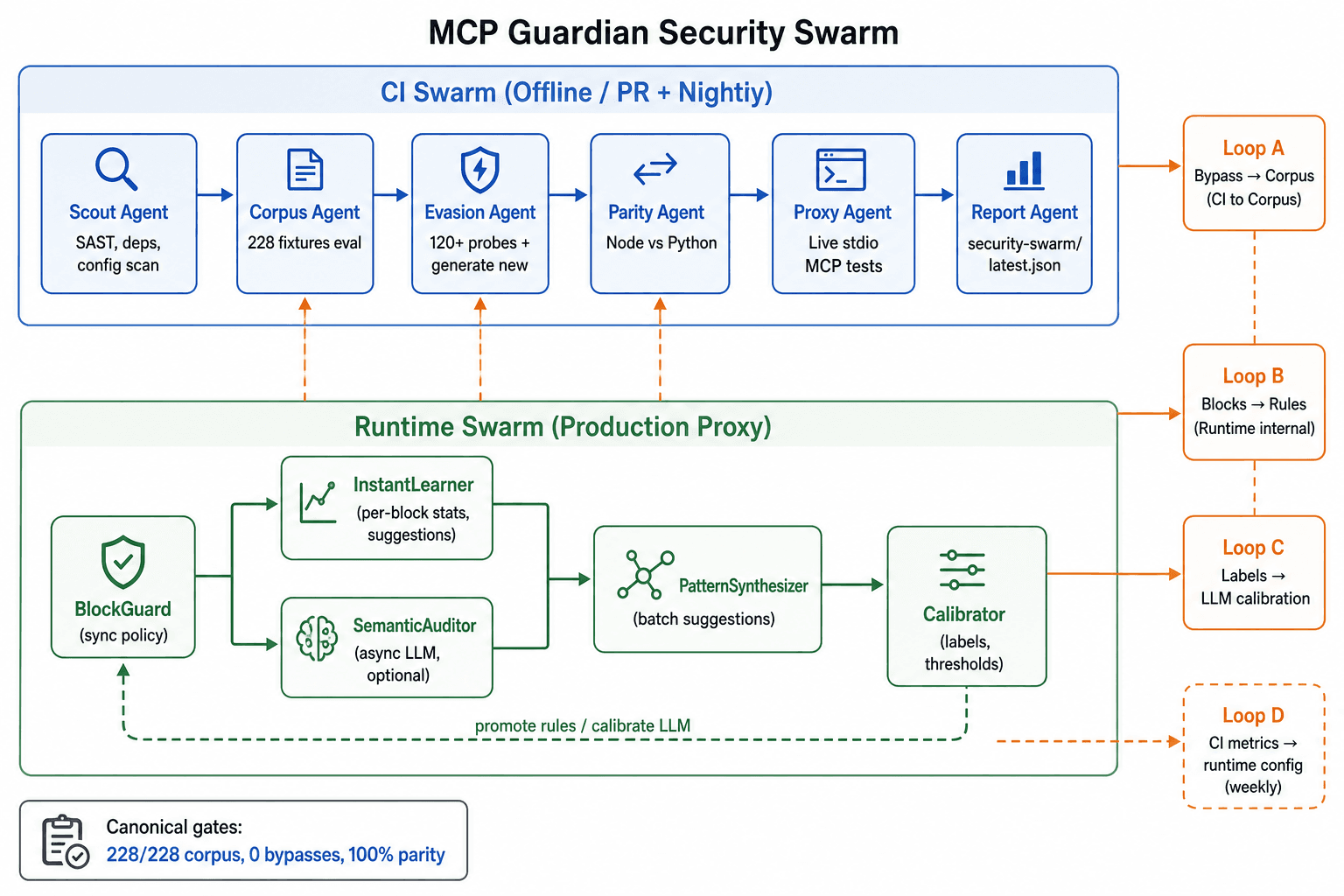
Two tracks: CI validates policy before merge; runtime learns from live proxy blocks. Solo analyze adds live MCP probes and dashboard reports.
Regex triage → schema validation → optional semantic LLM with circuit breaker and local fallback.
TR39 confusables offline, chaining patterns, fast block on obvious injection and exfil paths.
Ajv validation, recursive depth limits, maxLength — catch malformed or oversized tool payloads.
Async tier-2 LLM audit, 10/min cap, 24h cache, Ollama/local fallback when API exhausted.
Pro-tier pipelines that turn live blocks and swarm bypasses into new adversarial fixtures. Human review for policy changes; autonomous corpus growth for regression.
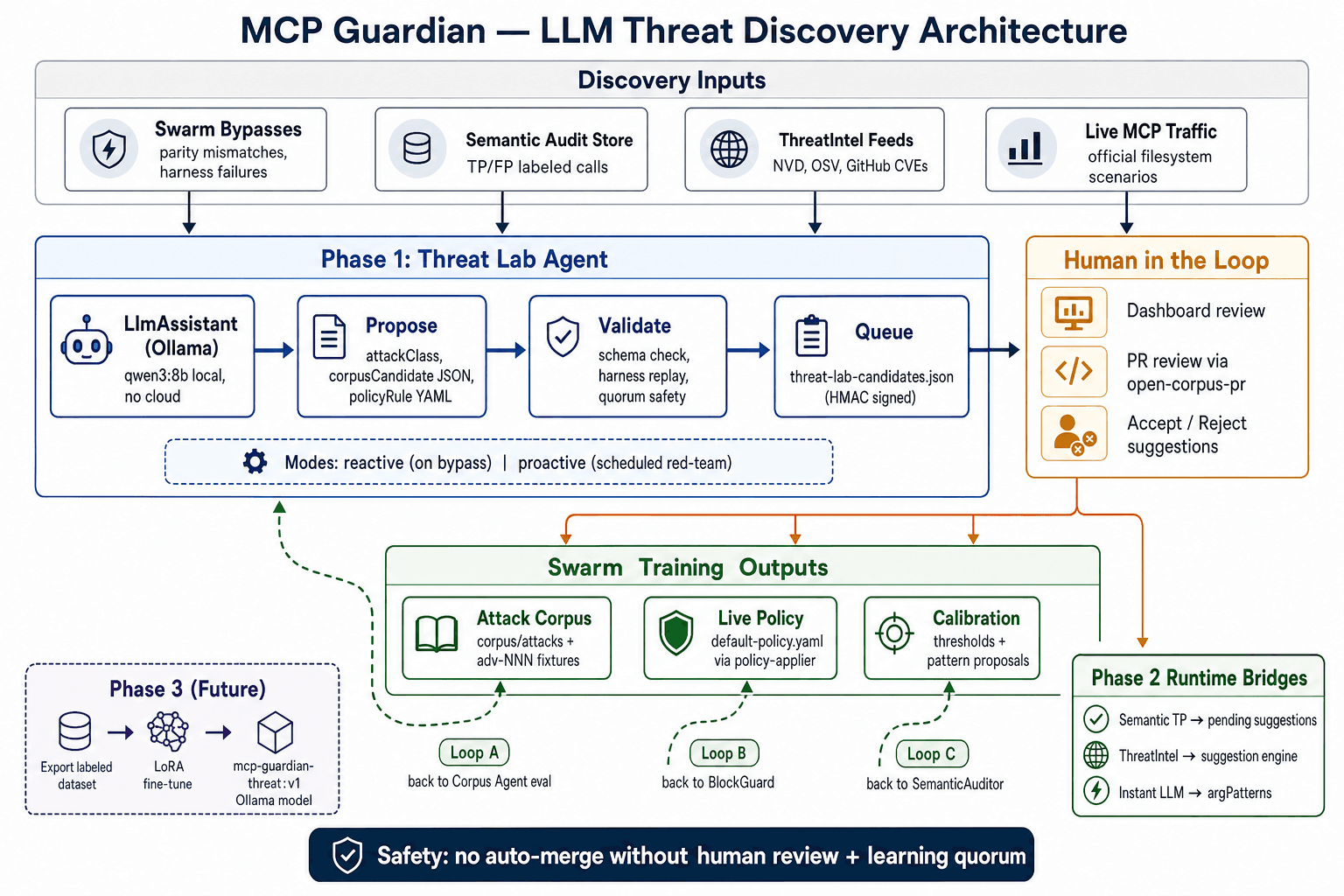
Swarm bypasses, semantic true-positives, ThreatIntel CVEs, and corpus attacks — authentic signals only.
No purpose-built MCP security competitor exists. Generic API gateways don't understand agent behavior — and brittle custom middleware breaks on every SDK update.
Understands tool call structure, rug-pull detection, typosquat scanning, and cross-tool chain attacks — not generic HTTP routing.
Years of adversarial research shipped in-repo. Competitors would need to replicate from scratch.
Live proxy traffic feeds LLM discovery pipelines that auto-generate new adv fixtures — no competitor has this loop.
Helm on K8s, Postgres RLS, DPoP OAuth, audit hash chain, mTLS hot-reload, multi-tenant JWT — drops into existing stacks.
| Capability | MCP Guardian | Generic gateway / DIY |
|---|---|---|
| MCP protocol native | Full stdio, HTTP, SSE, WebSocket | HTTP-only; breaks on SDK updates |
| Prompt injection / tool-chain detection | 557+ fixtures + normalization pipeline | Custom middleware; YAML-only misses ~75% |
| Response DLP + secret scanning | 267 rules, context-aware redaction | Not applicable |
| Continuous red-team loop | Security Swarm + Auto Threat Research | Manual pen tests |
| Compliance overlays | HIPAA, PCI-DSS, GxP templates + audit chain | Build your own |
| Deployment | Helm chart, <1h on existing K8s | Weeks of custom integration |
CISO and VP Engineering buyers · platform / AI infra deployers · Kubernetes + Postgres + OIDC already in place.
AI agents over transaction APIs and payment databases — CISO buyer, platform team deploys.
EHR and patient-record workflows — HIPAA audit trail, immutable JSONL hash chain.
500–10,000 employee companies shipping agents to customer data — SOC2 access logging built in.
Self-hosted open source with optional cloud control plane and lifetime Pro license.
Drop-in for Cursor, Cline, and Claude Code — enforce YAML policy on every MCP tools/call without changing agent code.
Regex triage (TR39 confusables) → Ajv schema validation → optional LLM semantic verdict with circuit breaker and local fallback.
Per-tenant token budgets, cost auditor, health monitors, and Grafana-ready SLO dashboards for production fleets.
JWT-bound tenants, Postgres RLS, DPoP, audit hash chain, mTLS hot-reload, and Helm enterprise overlay.
Browser SPA with WebSocket feed, policy editor, swarm reports, ThreatIntel polling, and SOC2-style access audit.
MIT Community proxy and harness on npm; optional Pro license for swarm CLI, fleet, AI learning, and semantic async.
Four evidence layers in the repo — use CI-gated harness numbers for procurement; synthetic sims are labeled explicitly.
| Suite | Result | Trust |
|---|---|---|
| Corpus (default-policy) | 154/154 blocked · 74/74 benign pass | CI-gated |
| Evasion probes | 148/155 blocked (7 tracked bypasses) | CI-gated |
| Node live integration | 26/26 stdio proxy tests | CI-gated |
| Python ↔ TS parity | 400/402 (99.5%) · 0 corpus mismatches | Offline mirror |
| Enterprise 5-scenario sim | 330 attacks · 93.33% block · 0 FP | Synthetic |
| Attack learning (long eval) | 5003 blocks · instant 41s vs batch 4.9h | Repo eval |
Full reports: adversarial-harness · enterprise-attack-sim
330 enterprise attack simulations · 93.3% block rate · 38ms average detection · zero false positives. Open-source core on npm; Pro unlocks Security Swarm, threat research pipelines, and fleet dashboard. AI agent security is the next major enterprise category — MCP Guardian is built to define it.
npm install is always free (MIT). Pro unlocks dashboard, Security Swarm CLI, fleet, AI learning, and multi-tenant JWT — validated against this control plane.
Proxy, CLI, local YAML policy, adversarial harness, and corpus eval — no license key. Sign in here to optionally manage cloud policy snippets and API keys.
Sign in (free)Install from npmLifetime license for self-hosted Pro: Security Swarm CLI, live dashboard, WebSocket feed, AI learning, fleet TUI, semantic async, multi-tenant bindings.
This site validates GUARDIAN_LICENSE_KEY at GET /api/v1/license. Free sign-in with Google or GitHub sends you to the repo to install Guardian; use the cloud console for policy YAML, tenant env snippets, API key rotation, and SSO launch into a running self-hosted dashboard.
Control plane URL (all buyers): https://mcp-guardian-cloud.vercel.app